

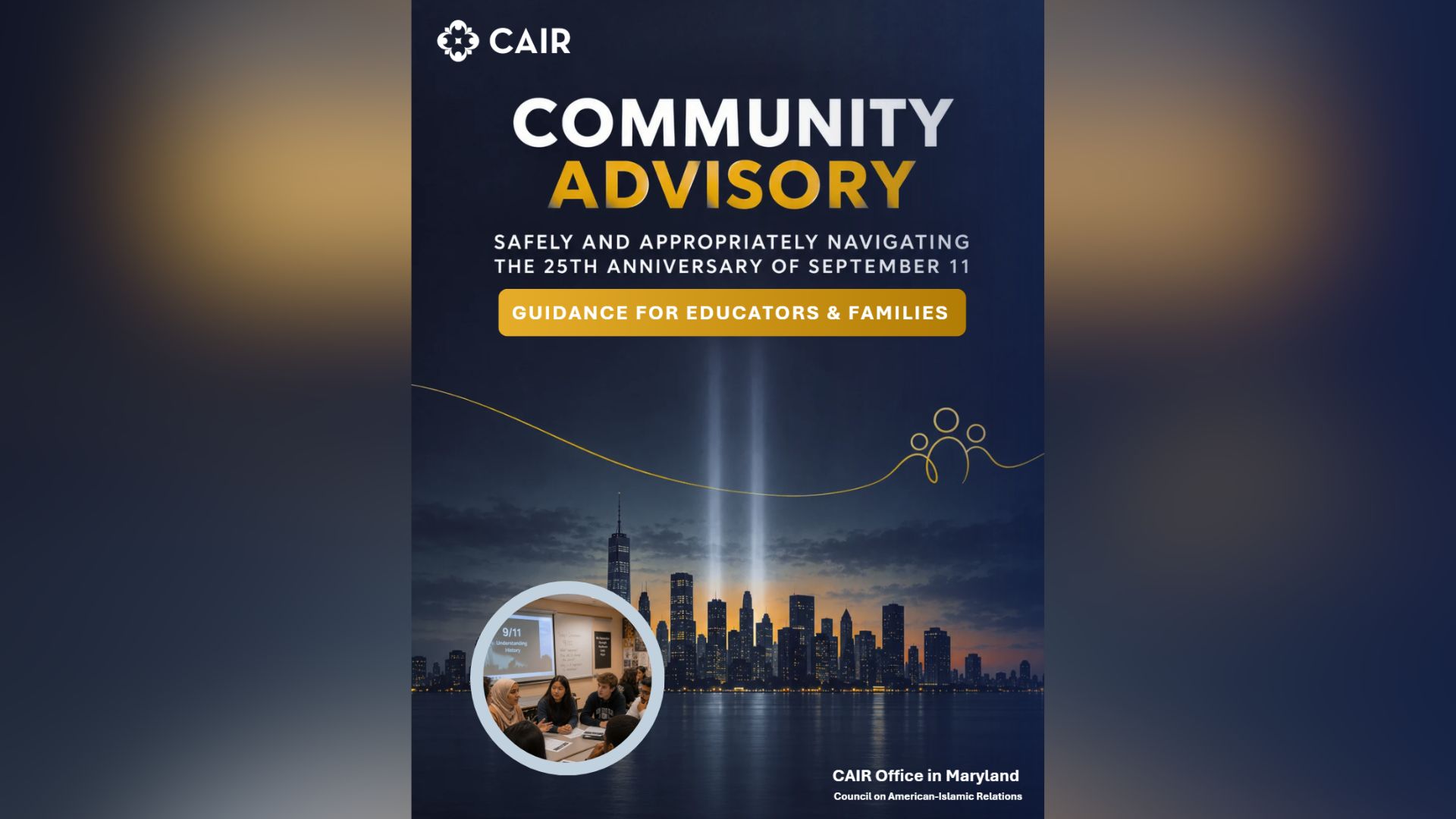
New guidance helps educators teach and commemorate 9/11 without marginalizing Muslim, Arab, Sikh or South Asian students, equips families to prepare children and respond to bias
(BALTIMORE, Md., 9/10/2026) – The Maryland office of the Council on American-Islamic Relations (CAIR) today announced the release of a comprehensive resource guide to help educators, school administrators and families safely and appropriately navigate the 25th anniversary of the September 11, 2001 terror attacks in Maryland public education.
Download “Safely and Appropriately Navigating the 25th Anniversary of September 11: Guidance for Educators and Families”
Friday, September 11, 2026 will mark 25 years since the attacks that killed nearly 3,000 people and caused profound grief. CAIR joins Americans across the country in honoring the victims, survivors, first responders and families impacted by this tragic event.
For today’s K-12 students, 9/11 is history rather than lived memory. Schools carry a special responsibility to teach the attacks accurately and sensitively, distinguish the perpetrators from an entire faith or population, and ensure that remembrance does not become a source of stereotyping, harassment, or humiliation.
CAIR offices have historically received reports around the anniversary involving Muslim students being blamed for the attacks, pressured to explain the attacks or defend their faith, subjected to “terrorist” and “bomb” jokes, or exposed to inflammatory and age-inappropriate classroom materials. Arab, Sikh, South Asian, Middle Eastern and other students perceived to be Muslim may also experience similar treatment. Heightened public attention surrounding the 25th anniversary may increase these risks.
“Schools have a special responsibility to teach the attacks accurately and considerately; to distinguish the perpetrators from an entire faith or community; and to prevent commemoration from becoming a source of fear, stereotyping, harassment or humiliation for Muslim, Arab, Sikh, South Asian and other students perceived to be Muslim,” said CAIR’s Maryland Director Zainab Chaudry.
CAIR Maryland urges schools to pair remembrance with preparation.
The resource guide includes:
Guidance for Educators and School Leaders
The guide urges Maryland schools to review planned lessons, assemblies, announcements and media before September 11 to ensure that all materials are factual, credible, age-appropriate and free of anti-Muslim or anti-Arab stereotypes.
Recommendations include:
- Centering the humanity of the victims, survivors, first responders and affected families.
- Not claiming that the attacks represent Islam or the world’s diverse Muslim population.
- Recognizing that Muslims were among those killed on 9/11 and among the first responders, health-care workers, service members and community members who assisted afterward.
- Providing age-appropriate context about the anti-Muslim, anti-Arab, anti-Sikh and anti-South Asian hate, discrimination, profiling, civil-liberties concerns and wars that followed the attacks.
- Briefing school personnel including administrators, teachers, substitutes, counselors, bus drivers, cafeteria staff, coaches, school resource officers and front-office employees about the possibility of anniversary-related misconduct.
- Reaffirming anti-bullying and nondiscrimination policies and explaining how students can report harassment, threats, doxxing and cyberbullying.
- Designating administrators, counselors and Title VI or nondiscrimination contacts to receive and address concerns.
- Preparing school counselors and mental-health professionals to support students affected by grief, post-9/11 hate, war, displacement or identity-based targeting.
- Informing families in advance about lessons, media and observances planned by the school.
- Interrupting biased or harmful comments immediately instead of expecting a targeted student to respond.
- Providing effective safety measures, counseling and follow-up when an incident is reported.
The guide also provides a sample classroom introduction educators can use to establish respectful expectations before beginning a 9/11 lesson or observance.
Practices Schools Should Avoid
CAIR Maryland advises educators and school leaders not to:
- Ask Muslim, Arab, Sikh or South Asian students to explain 9/11, condemn terrorism, defend Islam or speak for an entire community.
- Assume a student’s religion, ethnicity, immigration status or connection to the attacks based on a name, appearance, accent, hijab, turban or other attire.
- Conduct simulations involving hijackers, victims or airport security screenings.
- Use graphic footage, images of people dying or recordings of final phone calls without a compelling, age-appropriate educational purpose and advance notice.
- Present conspiracy theories, inflammatory social-media posts or polemical materials as credible historical sources.
- Permit slurs, terrorist references, bomb jokes or collective-blame statements under the guise of debate or free expression.
- Treat a student’s silence, distress or request to leave the room as evidence of disloyalty or support for violence.
- Turn a memorial observance into a religious exercise or loyalty test.
Guidance for Maryland Muslim Families
The family section of the guide offers practical recommendations to help parents and families prepare children without frightening them.
Families are encouraged to ask schools in advance:
- What lesson, assembly or observance is planned?
- What videos, images, readings or guest speakers will be included?
- How will the school prevent stereotyping and address biased comments?
- Will a counselor or another trusted adult be available?
- Is an alternative available if graphic or emotionally distressing material will be shown?
The guide also encourages parents to begin age-appropriate conversations at home, identify trusted adults their children can approach at school and practice simple responses children can use if confronted with stereotypes or harassment.
Children should understand that the 9/11 attacks killed people of many faiths and backgrounds, including Muslims, the perpetrators did not represent Islam or ordinary Muslims, no child is responsible for explaining or defending an entire religion, and that children do not owe anyone a debate and should prioritize leaving an unsafe situation and seeking help from a trusted adult.
If a child is targeted, CAIR recommends that families:
1. Secure the child’s immediate safety. Contact school leadership and emergency services if there is an imminent threat or injury.
2. Listen and reassure. Tell the child that they are believed, the incident is not their fault and they did the right thing by reporting it.
3. Document the incident. Record dates, times, locations, exact words, witnesses and prior incidents. Preserve original emails, screenshots, videos, URLs, usernames, photographs, voicemails and relevant schoolwork.
4. Report the incident in writing. Contact the teacher and principal or designated administrator and submit the school district’s bullying or harassment form when available.
5. Request specific action. Ask for written confirmation, immediate safety measures, an investigation under applicable policies, preservation of evidence, protection against retaliation and a date for follow-up.
6. Escalate when necessary. If the response is delayed or ineffective, contact the superintendent’s office and CAIR’s Maryland office at [email protected].
7. Support the child’s recovery. Request counseling, check-ins with a trusted adult, academic flexibility, safe transportation or other appropriate measures. A school’s solution should not punish, isolate or unnecessarily displace the targeted child.
Federal civil-rights protections may apply when a student experiences a hostile environment based on actual or perceived shared ancestry or ethnic characteristics, including stereotypes associated with being Muslim, Arab, Palestinian, Sikh, South Asian or Middle Eastern. Retaliation for reporting discrimination or participating in a civil-rights process is prohibited.
Additional resources:
CAIR Maryland 2026-27 School Resource Guide:
https://bit.ly/2026-md-schoolresourceguide
CAIR Maryland 2026 Anti-Bullying Toolkit:
https://bit.ly/md-antibullying
CAIR Teaching September 11 Resource Guide:
National September 11 Memorial & Museum K-12 Lesson Plans:
https://www.911memorial.org/learn/students-and-teachers/lesson-plans
CAIR Maryland is available to consult with schools, meet with families, review concerns and provide educational training. To confidentially report a bias, bullying or discrimination incident, or to request a free copy of the guide, share feedback or seek assistance, email [email protected] with the subject line “9/11 Resource Guide” or call 410-261-6544.
CAIR’s mission is to protect civil rights, enhance understanding of Islam, promote justice, and empower American Muslims.
La misión de CAIR es proteger las libertades civiles, mejorar la comprensión del Islam, promover la justicia, y empoderar a los musulmanes en los Estados Unidos.
END
CONTACT: CAIR Maryland Director Zainab Chaudry, [email protected], 410-971-6062; CAIR National Communications Director Ibrahim Hooper, 202-744-7726, [email protected]; CAIR National Communications Manager Ismail Allison, 202-770-6280, [email protected]