

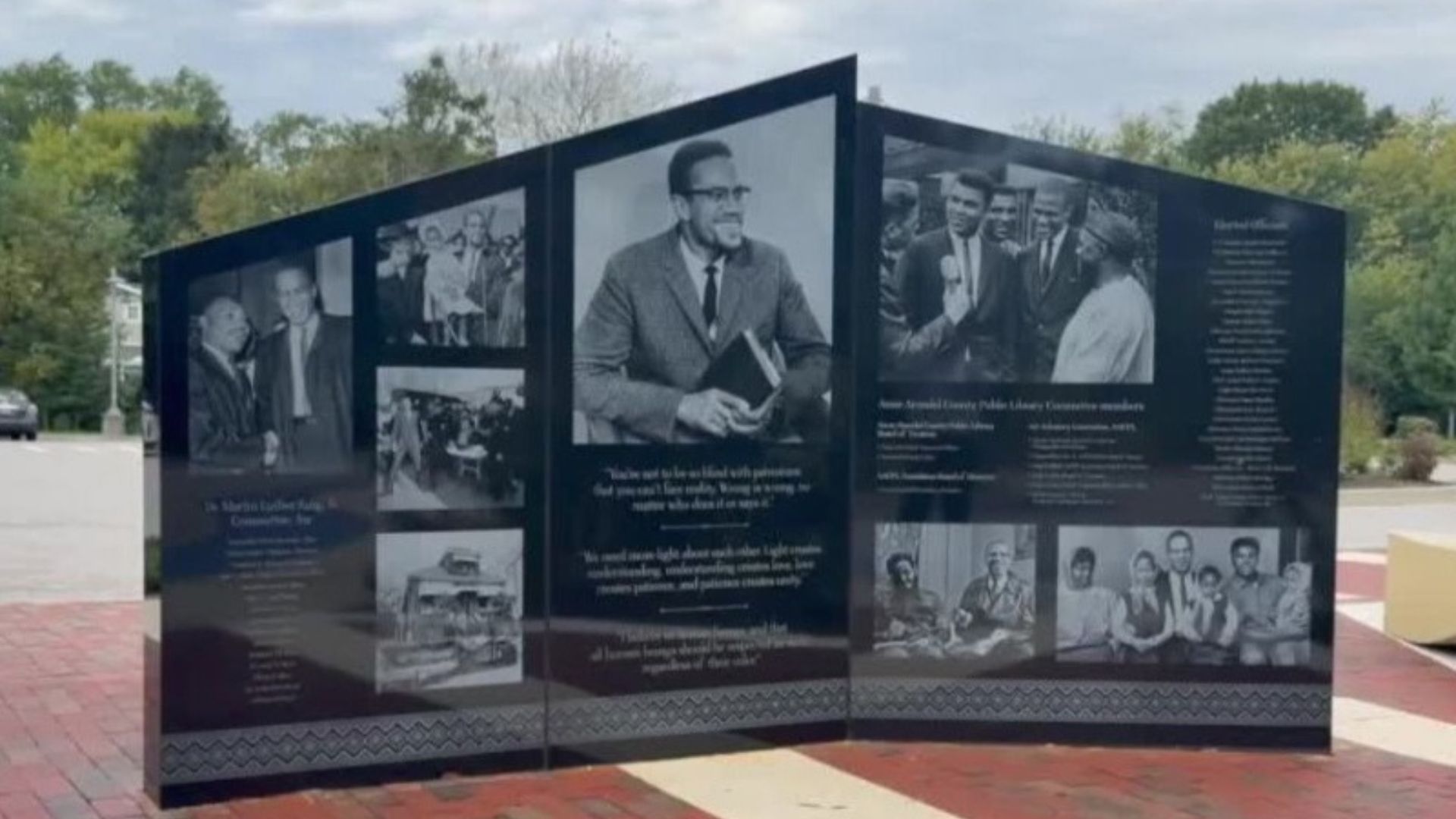
Letter from Select Advocates, CAIR included in monument’s time capsule, scheduled to remain sealed until 2076
The Maryland office of the Council on American-Islamic Relations (CAIR), the nation’s largest Muslim civil rights and advocacy organization, today welcomed the unveiling of Maryland’s first and only public monument honoring El-Hajj Malik El-Shabazz, widely known as Malcolm X, outside the Michael E. Busch Annapolis Library.
The monument honors a transformative Muslim leader whose insistence on Black dignity, self-determination and human rights continues to inspire movements for justice. It also contains a time capsule preserving messages about the future of race relations in America, intended to remain sealed until 2076, the nation’s 300th anniversary. Elected officials and community members have contributed their reflections to this message to future generations.
SEE: A new memorial honoring Malcolm X unveiled in Annapolis
CAIR thanked the Caucus of African American Leaders, its convener Carl Snowden, and the organizers, donors and community partners whose commitment helped bring this initiative to fruition.
In a statement, CAIR’s Maryland Director Zainab Chaudry said:
“Who we honor in our public spaces tells an enduring story about whose lives matter, whose struggles deserve remembrance and what principles we expect our society to defend. By honoring El-Hajj Malik El-Shabazz, Maryland affirms that Black dignity, Muslim identity and the courageous pursuit of justice belong at the heart of our shared history.
“Malcolm X challenged a nation to confront the violence and hypocrisy of racism. He demanded that Black people be recognized as fully human, entitled to safety, freedom and the power to shape their own futures. His legacy continues to challenge us wherever discrimination is excused, history is distorted or demands for equality are treated as a threat.
“We thank the Caucus of African American Leaders and Carl Snowden for their support and dedication to this initiative. Their work demonstrates the power of communities coming together to ensure that our public spaces reflect a fuller, more honest account of who we are.
“I am deeply honored that my letter is included in the monument’s time capsule. When future generations open it in 2076, they will inherit our words alongside the consequences of our choices. Our responsibility is to help build a society in which the equality we promise today becomes the reality they experience tomorrow.”
CAIR said understanding El-Hajj Malik El-Shabazz requires recognizing the central place of Islam in his life and the evolution of his vision. His 1964 pilgrimage to Mecca deepened his understanding of human solidarity across racial boundaries while preserving his unwavering opposition to injustice. His faith and advocacy remain an enduring part of both African American and Muslim American history.
The organization emphasized that placing the monument at a public library creates an opportunity for generations of visitors to encounter that legacy, ask difficult questions and examine the relationship between historical memory and present responsibility.
CAIR said the time capsule’s question about the future of race relations must also be understood as a call to action in the present:
“A monument can preserve a legacy, but people must carry its work forward,” CAIR added. “The strongest tribute we can offer El-Hajj Malik El-Shabazz is to confront anti-Black racism, challenge Islamophobia, protect civil rights and stand with people whose humanity is under attack. In 2076, let this monument stand in a society that has earned the progress we hope to describe.”
END
CONTACT: CAIR National Deputy Director Edward Ahmed Mitchell, 404-285-9530, [email protected]; CAIR Government Affairs Director Robert McCaw, 202-742-6448, [email protected]; CAIR National Communications Director Ibrahim Hooper, 202-744-7726, [email protected]; CAIR National Communications Manager Ismail Allison, 202-770-6280, [email protected]