

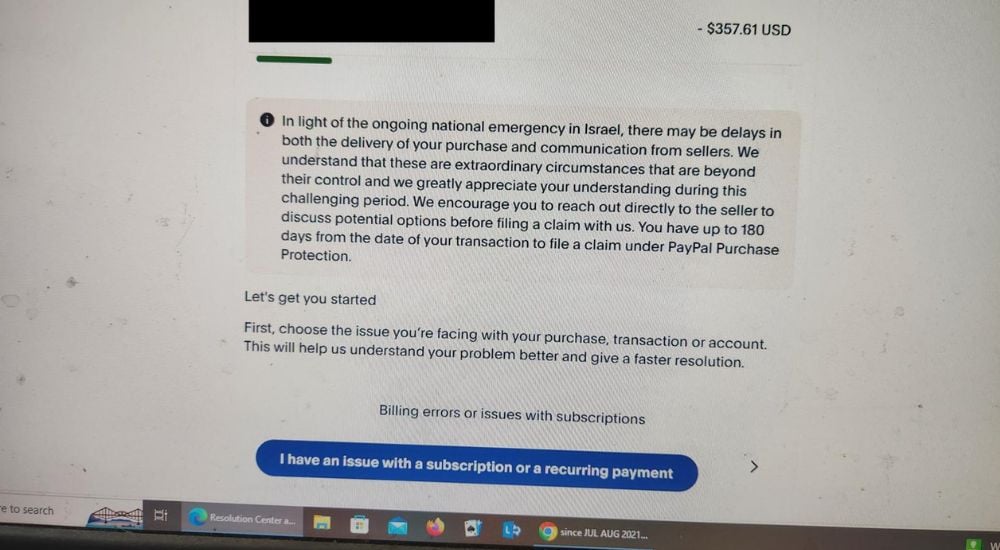
The Council on American-Islamic Relations (CAIR), the nation’s largest Muslim civil rights and advocacy organization, today called on PayPal to explain why a Maryland-based Muslim’s routine donation to an Islamic place of worship in Ohio was apparently delayed “[i]n light of the ongoing national emergency in Israel.”
This statement appeared in a screenshot of the complainant’s PayPal account that was provided to CAIR. [Note: The names of both the complainant and the recipient of the donation are both being withheld for their privacy and safety.]
“Donating to a place of worship is entirely normal and banking while Muslim is not a crime,” said CAIR Research & Advocacy Director Corey Saylor. “There was no reason for PayPal to seize an American’s donation to an American house of worship apparently because of the completely unrelated crisis in Israel and Palestine then backtrack without explanation. PayPal must explain why this happened and ensure that it is not targeting transactions conducted by Muslim customers amid a nationwide surge in anti-Muslim and anti-Palestinian discrimination.”
Saylor added, “This incident has the hallmarks of ‘Banking While Muslim,’ a set of discriminatory financial practices that target communities of color, including Iranian and Muslim Americans.”
BACKGROUNDER:
According to information reported to CAIR, the complainant and their family had benefited from online classes provided by an Ohio-based Islamic foundation. The family had reportedly donated on a monthly or bimonthly basis for nearly two years, at times using a PayPal account to facilitate these transactions.
However, a November donation to the foundation was reportedly flagged for review by PayPal. In a screenshot provided to CAIR, PayPal reportedly posted a message to the complainant’s account saying, “In light of the ongoing national emergency in Israel, there may be delays in both the delivery of your purchase and communication from sellers.” [Emphasis added.] This message was reportedly removed from the account the following day.
Nearly two months following the initial delay, PayPal had failed to resolve the case and refund the complainant’s money. According to screenshots provided to us, the platform regularly changed the estimated resolution date, without offering further explanation to the complainant.
On Jan. 9, Saylor wrote PayPal raising these concerns. Later that same day, the complainant reported receiving a note from PayPal saying, “that PayPal completed its review and released the payment hold today.” PayPal’s note further added that their notification of the hold on the payment “did not at any point in time contain any information related to the Israeli/Palestinian conflict.”
Saylor sent the screenshot the complainant provided to PayPal on January 11. Neither the complainant nor CAIR have heard anything further from PayPal.
Last year, CAIR supported a call by 11 members of Congress for PayPal to end its discriminatory ban on doing business with Palestinians in the occupied territories, while at the same time permitting illegal Israeli settlers to use the payment platform.
For years, community members and non-profit organizations have reported to CAIR that their bank accounts had been closed, or transactions have been held, without explanation. To date, no one has had any substantive recourse to find out why the problem occurred or challenge it.
In a July 21, 2022, memo dedicated to ending the discriminatory bank account closures at the center of the Omar-Warren letter, the National Iranian American Council (NIAC) describes the problem this way, “U.S. sanctions and extensive federal regulations like the Patriot Act encourage discrimination from banks.” NIAC adds, “the Patriot Act imposes a broad mandate that many banks appear to judge as only enforceable through national origin or heritage discrimination.”
SEE: Memo: Ending Discriminatory Bank Account Closures
In late 2022, CAIR welcomed a joint U.S. House and Senate letter signed by 22 lawmakers addressed to the Biden Administration and the heads of all U.S. banking regulators calling on them to “improve banking access for immigrant communities and communities of color,” including Iranian and Muslim Americans.
END
CONTACT: CAIR National Research and Advocacy Director Corey Saylor, 202-384-8857, csaylor@cair.com; CAIR National Research and Advocacy Coordinator Farah Afify, 202-742-6410, fafify@cair.com CAIR National Deputy Director Edward Ahmed Mitchell, 404-285-9530, e-Mitchell@cair.com; CAIR Government Affairs Director Robert McCaw, 202-742-6448, rmccaw@cair.com; CAIR National Communications Director Ibrahim Hooper, 202-744-7726, ihooper@cair.com; CAIR National Communications Coordinator Ismail Allison, 202-770-6280, iallison@cair.com