

Civil rights complaints reported to the organization remain at an all-time high
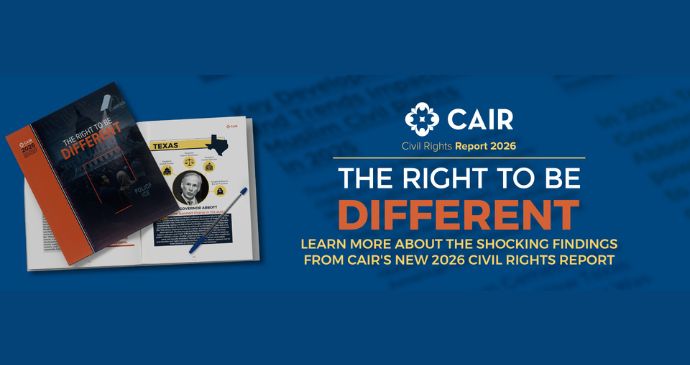
The Council on American-Islamic Relations (CAIR), the nation’s largest Muslim civil rights and advocacy organization, today released its 2026 Civil Rights Report “The Right to be Different,” which documents a pattern of public officials using their offices to narrow the definitions of what Americans can look like, say, or believe in 2025.
WATCH CAIR’S NEWS CONFERENCE ANNOUNCING THE REPORT.
SEE: 2026 Civil Rights Report: The Right to be Different
SEE: Trump crackdown on protests and immigration led to Islamophobia, Muslim group says – Reuters
“In 2025, powerful public officials argued—explicitly or by implication—that ‘freedom’ means the right to be like them: to speak the approved lines, worship the approved way, and trace ancestry to approved places,” said CAIR Research and Advocacy Director Corey Saylor. “Protecting the right to be different is not a favor to any one community. It is the operating system of a free country.”
CAIR’s research staff identify five key trends in the report:
- Florida, Illinois, Minnesota, Oklahoma, and Texas are national standouts in a record-setting year. Florida, Illinois, Minnesota, Oklahoma, and Texas have all seen increasing complaints in each of the last three years. CAIR received 8,683 complaints nationwide in 2025, the highest number of single-year complaints CAIR has recorded since our first civil rights report covering 1996 was published. This was a 0.3 percent increase from the 8,658 complaints reported in 2024. CAIR-Minnesota reported 693 complaints in 2025, a 96 percent increase over 2024. Twenty-three percent of their year total was recorded in December. CAIR-Chicago reported 877 complaints in 2025, a 65 percent increase over 2024.
- Anti-Muslim narratives more clearly resurfaced in 2025, particularly the notion that the religious principles followed by Muslims are inherently threatening and anti-American. In 2025 extreme policies—five bills introduced at the federal level—that would effectively ban the practice of the world’s second-largest religion in the United States or entry of its adherents into the nation were proposed. (For example, H. R. 5512) By February, Texas Governor Abbott was instigating a campaign against Muslim life in Texas while claiming he banned sharia. In December, Reps. Chip Roy (R-TX) and Keith Self (R-TX) founded the “Sharia-Free America Caucus.” As of late February 2026, they claimed 45 members. Member remarks make it clear that Islam is the target of the caucus’ work. In a speech at Turning Point USA’s AmericaFest in December, Director of National Intelligence Tulsi Gabbard claimed that American Muslims are working to impose “sharia law” and “Islamic principles” across America through the “use of laws or violence,” specifically citing the cities of Paterson, New Jersey, and Houston, Texas.
- Government officials used collective and ideological punishment to target both non-citizens and citizens who are perceived to be ethnically or ideologically undesirable. The report documents three Muslim majority groups–Afghans, Somalis, and Syrians–that were targeted. Framing speech supporting Palestinian human rights as inherently threatening and biased, the Trump administration justified high-profile detentions based on the targeted individual’s viewpoints. At least three students and a journalist were the subjects of widely publicized arrests and allegations of wrongdoing. In each instance, court evidence did not support the allegations. By September, a federal judge ruled in a case brought by the American Association of University Professors and the Middle East Studies Association that government officials “deliberately and with purposeful aforethought” coordinated two federal agencies to “intentionally to chill the rights to freedom of speech and peacefully to assemble” of members of a Middle Eastern professor’s organization.
- Discretionary powers replaced normal civil rights safeguards. A defining feature of 2025 was the increased use of discretionary authority—executive proclamations, emergency powers, immigration discretion, regulatory investigations, and funding conditions—to achieve outcomes that would likely fail under traditional evidentiary or judicial scrutiny.
- Constitutional rights narrowed. By the end of 2025, the legal status of American Muslims remained formally unchanged, but the conditions under which rights could be exercised had narrowed. Equal access to social opportunities—education, travel, civic participation, and nonprofit activity—was increasingly contingent on political alignment, silence, or litigation capacity. Equal protection depended less on neutral administration and more on after-the-fact judicial correction.
The analysis paints a grim picture while also demonstrating impactful options exercised by civil rights defenders. American Muslims and allied institutions exercised agency through legal action, public advocacy, and institutional engagement. Litigation proved relatively effective in asserting constitutional boundaries, with courts repeatedly rejecting censorship and viewpoint discrimination while protecting some rights to privacy. These interventions demonstrated that formal legal protections remain operative—with the caveat that litigation is often reactive rather than preventive. Courts and public pressure provided partial correctives, largely after harm had occurred and often at the very latest of stages.
CAIR’s mission is to protect civil rights, enhance understanding of Islam, promote justice, and empower American Muslims.
La misión de CAIR es proteger las libertades civiles, mejorar la comprensión del Islam, promover la justicia, y empoderar a los musulmanes en los Estados Unidos.
END
CONTACT: CAIR Research and Advocacy Director Corey Saylor, 202-384-8857; CAIR National Deputy Director Edward Ahmed Mitchell, 404-285-9530, [email protected]; CAIR National Communications Director Ibrahim Hooper, 202-744-7726, [email protected]; CAIR National Communications Manager Ismail Allison, 202-770-6280, [email protected]