

The Council on American-Islamic Relations (CAIR), the nation’s largest Muslim civil rights and advocacy organization, today welcomed the Senate Health, Education, Labor and Pensions (HELP) Committee delaying a vote on its considering of the misleadingly titled Antisemitism Awareness Act (S. 558), following bipartisan concerns over the act dangerously conflating criticism of the Israeli government with antisemitism and threatens to chill free speech on college campuses nationwide.
While voting on the unconstitutional act was postponed, the Senate HELP Committee did adopt several amendments affirming First Amendment protections, including the right to criticize the war in Gaza, oppose Israeli leadership, and participate in campus protests and non-violent speech. These measures received backing from all Democrats and a few Republicans, including Senators Rand Paul and Susan Collins, casting doubt on the bill’s ability to advance because of members who do not support free speech protections for any criticism of the Israeli government.
S. 558 and S. 163 | Senate Committee on Health, Education, Labor and Pensions
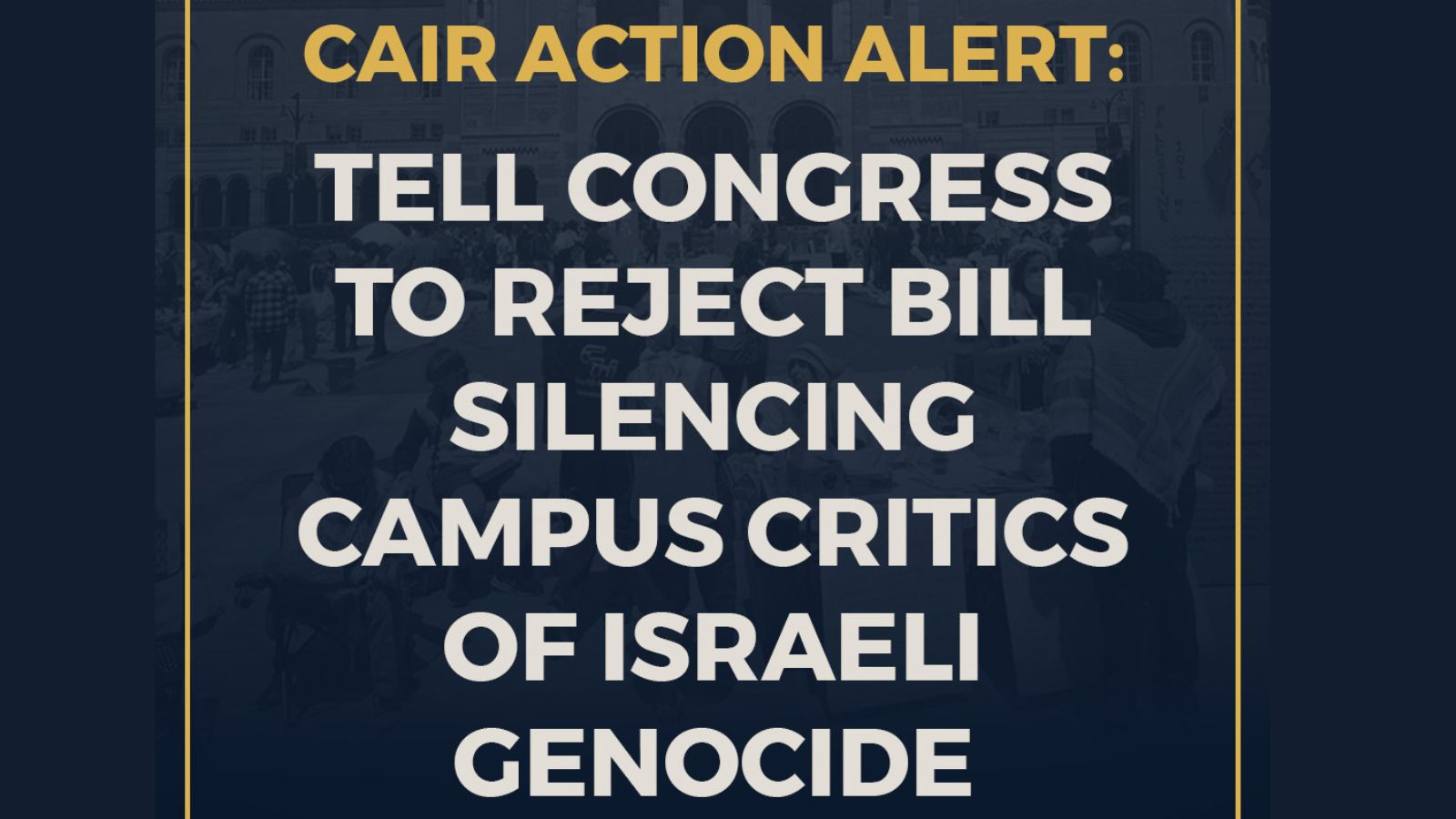
Last week, CAIR launched an action alert urging the U.S. Senate to oppose the act. CAIR continues to urge all Americans to keep messaging their members of Congress to oppose the bill. The bill is not defeated, and could come up for a vote sometime soon.
CLICK HERE: SEND YOUR MESSAGE TO CONGRESS TODAY📣
In a statement, CAIR Director of Government Affairs Department Robert S. McCaw said:
“We applaud the senators who raised the alarm today about the dangerous implications of this bill. The Antisemitism Awareness Act is not about protecting Jewish students, it’s about silencing students who dare to speak out against apartheid, occupation, and genocide. Equating criticism of Israel with antisemitism undermines the fight against real antisemitism and weaponizes civil rights law to punish political dissent. This delay is a victory for free speech and a reminder that our Constitution must not be sacrificed for political convenience.”
The bill, introduced by HELP Committee member Senator Tim Scott (R-SC), if enacted, would grant President Trump sweeping new powers to suppress peaceful anti-genocide protests under the false pretense of combating antisemitism. CAIR notes that a companion bill has been introduced in the U.S. House of Representatives by Rep. Michael Lawler (R-NY) as H.R. 1007.
During the markup, senators from both parties raised serious First Amendment concerns:
Ranking Member Sen. Bernie Sanders (I-VT) powerfully opposed the bill with an opening statement affirming that while “antisemitism must be condemned,” he called the act clearly “unconstitutional” and warned it “will move us far along in the authoritarian direction that the Trump administration is taking us.”
Sanders added, “Unfortunately and unacceptably, the Antisemitism Awareness Act we are considering today would label speech that criticizes the Israeli government and Netanyahu’s horrific war in Gaza as antisemitic and a violation of civil rights laws, and that is an extremely dangerous precedent.”
Sen. Rand Paul (R-KY) also opposed the bill, urging more time for discussion and emphasizing its constitutional dangers: “Discussing the First Amendment ramifications of something that will alter the First Amendment and will affect every college student in America, I think, is important enough.”
He further noted, “If you look at the IHRA examples of speech that they are going to be limiting on college campuses, everything on that list is politically protected by the First Amendment.”
Senator Chris Murphy (D-CT) rejected the bill stating: “If you read these examples (of antisemitism) which are going to be incorperated by law into this new definition it absolutly opens up the possibility that criticism of Israel, for instance, suggesting that there is discrimination or bias against Palestinians connected to the decisions that the [Israeli] government is making as actions or speech that could ultimately cause your federal funding to be in jepordy. That if you argue there was bias or discrimination inherent in the exercise of the U.S. government, you would not be held liable, you would not be at risk of losing your federal funding, but under this definition, which includes the examples there is a real potential that firstmentdment protected speech, criticism of Isreal, the policies of Isreal will end up getting you in trouble and putting your federal funding at risk.”
Senator Tim Kaine (D-VA) also explained why he would oppose the bill, stating: “I am not aware of a single other civil rights bill where we are condemning behavior but, in the statute, saying, ‘this may or may not be an example of the bad behavior.’ We don’t do this in civil rights statutes. So from the beginning, from a draftsmanship standpoint—antisemitism is very serious, calling someone an antisemite is very serious—and I don’t think we should put into the statutory definition a set of examples that are, ‘well maybe it is, maybe it isn’t.’ We would be setting a very bad draftsmanship precedent, number one. Number two, of the 11 IHRA examples, seven are really about Israel, and four are about antisemitism—about Jews. Seven are really about Israel. And for the reasons mentioned earlier, yesterday, the head of Shin Bet resigned in Israel and leveled a very tough set of charges against the prime minister and the Israeli government. I think much of what he said would violate this definition. We should allow people to state tough, tough points of view, even if we don’t agree with them. … So I am going to oppose the bill. If we could have had the votes to remove the examples, I would have supported it, but I am going to oppose the bill.”
In opposing the bill, Senator Ed Markey (D-MA) also stated: “Mr. Chairman, Antisemitism is wrong, authoritarianism is not the answer, that’s what we are debating right now, we’re debating what the rights are of all Americans to participate in a debate, the when a young person writes an op-ed in the student newspaper and get whisked off of the streets of Tuffs University to a prison in Louisiana with no charges that is what we are debating today.”
[CAIR notes that last week Senator Markey joined a bicameral Democratic congressional delegation to conduct an oversight visit of ICE facilities in Louisiana to meet with wrongfully detained anti-genocide activists, recent Columbia University graduate student Mahmoud Khalil and Tufts University Ph.D. student Rumeysa Ozturk, and to demand their immediate release.]
Since returning to the office, President Trump has, under the false pretense of combating antisemitism, revoked more than 1,700 student visas, many targeting Muslim, Palestinian, and allied students involved in peaceful anti-genocide protests. Among those affected are Mahmoud Khalil, a recent Columbia University graduate, and Rumeysa Ozturk, a Tufts University Ph.D. student. Both have been wrongfully detained for opposing Israel’s genocide in Gaza. Neither has been accused of any crime, but rather of effectively shifting the national dialogue on the United States’ complicity in Israel’s ongoing human rights abuses, genocide, and ethnic cleansing.
BACKGROUND:
The Antisemitism Awareness Act would require the Department of Education to adopt the IHRA working definition of antisemitism. This definition conflates criticism of Israel’s government, history, and ideology with antisemitism and is already being weaponized to wrongfully arrest, detain, and possibly deport student protestors and criminalize support for Palestinian human rights.
CAIR maintains that true antisemitism must be opposed in all forms, but that this bill weaponizes that concern to silence critics of Israel’s occupation, apartheid, and ongoing genocide in Gaza, especially Muslim, Arab, Jewish, and allied students protesting for justice.
Kenneth S. Stern, the original drafter of the IHRA definition, has warned against codifying it into law, saying it would be used to suppress political speech and harm academic freedom.
Representative Jerrold Nadler (D-NY) criticized earlier versions of the bill, warning that it would chill constitutionally protected speech. Representative Thomas Massie (R-KY), one of the few House Republicans to oppose it, cautioned against adopting any single definition that blurs the line between hate and dissent.
The bill has repeatedly failed to become law because of widespread concerns over its impact on free speech. Though the House has passed the bill in past sessions, it has never been adopted by the full Congress due to its deeply controversial and legally flawed premise.
CAIR urges Congress to reject S. 558 and instead focus on addressing the real and growing threats of anti-Palestinian, anti-Muslim, and antisemitic discrimination, without infringing on First Amendment rights.
END
CONTACT: CAIR National Deputy Director Edward Ahmed Mitchell, 404-285-9530, [email protected]; CAIR Government Affairs Director Robert McCaw, 202-742-6448, [email protected]; CAIR National Communications Director Ibrahim Hooper, 202-744-7726, [email protected]; CAIR National Communications Manager Ismail Allison, 202-770-6280, [email protected]