

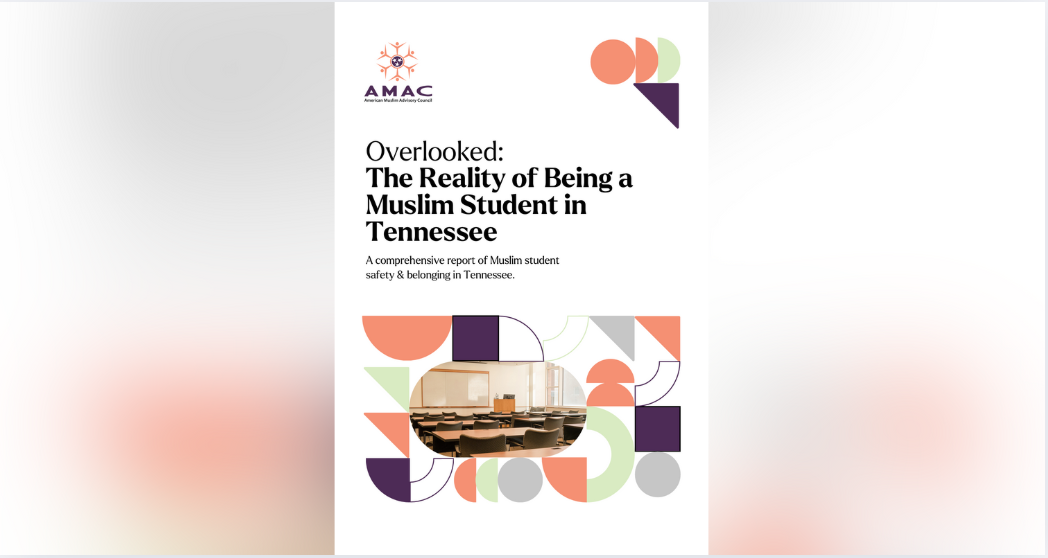
The Council on American-Islamic Relations (CAIR), the nation’s largest Muslim civil rights and advocacy organization, today expressed concern following a report by American Muslim Advisory Council (AMAC), which found that almost half of Muslim students in Tennessee report faith-based bullying.
That AMAC survey of Muslim families and students found 46 percent of students reported experiencing faith-based bullying, while 68 percent said teachers rarely intervened.
CAIR commended AMAC for conducting and publishing the report, calling it an essential step toward addressing the persistent problem of anti-Muslim bias in schools.
SEE: Nearly half of Muslim students in Tennessee report faith-based bullying, new report claims
“The findings of this survey reflect what we’ve been hearing from students and parents. No child should feel unsafe or unwelcome in school because of their faith,” said Sabina Mohyuddin, Executive Director of AMAC. “These numbers are a wake‑up call for schools, families, and policymakers across Tennessee.”
“No student should feel unsafe or unwelcome in the classroom because of their faith,” said Corey Saylor, CAIR’s Research and Advocacy Director. “This important report by the American Muslim Advisory Council reflects a broader, national trend of rising anti-Muslim bullying that requires immediate attention from educators, administrators and policymakers.”
Saylor added that Washington, D.C., based CAIR offers “An Educator’s Guide to Islamic Religious Practices,” designed to assist teachers, principals, administrators and other educators in formulating and implementing policies and programs that will help to create a supportive academic environment.
SEE: An Educator’s Guide to Islamic Religious Practices
He noted that earlier this year, CAIR’s Massachusetts chapter released a report, titled “Silenced Voices: Examining Bullying and Islamophobia in Massachusetts Public Schools,” indicating that nearly half of the participants have experienced bullying due to their religious identity.
Last year, CAIR urged all institutions of higher education and K-12 schools to protect anti-genocide students as National Bullying Prevention Month began in October.
Saylor said schools have a legal obligation under Title VI of the Civil Rights Act of 1964 (Title VI) to provide all students, including students who are or are perceived to be Palestinian, Arab, or Muslim, a school environment free from discrimination based on race, color, or national origin.
The First Amendment also prohibits “viewpoint discrimination” – government action, which includes action by public university officials, that burdens or suppresses speech based on viewpoint.
CAIR encourages any students experiencing discrimination and/or harassment to report it to our offices and to consult the following guides for resources and information on student and parent rights.
SEE: CAIR’s Guide Against Bullying and Bias in Schools: Practical Steps for Youth and Their Families
SEE: Guidance for Students Targeted in Response to Palestine Rights Advocacy
BACKGROUNDER:
In 2023, CAIR received a total of 921 education-related complaints, which includes bullying and education discrimination, a 219% increase over the previous year. In 2024, 84% of Muslim students in higher education or in a trade/vocational program reported experiencing religious discrimination in the last year, according to the Institute for Social Policy and Understanding.
SEE: CAIR-NY: Feeling the Hate In Our Schools
SEE: New CAIR-CA Report Shows Muslim Students Are Bullied at Twice the National Average
SEE: ISPU:American Muslims, Especially Students, Most Likely to Experience Religious Discrimination
END
CONTACT: CAIR Research and Advocacy Director Corey Saylor, 202-384-8857, [email protected]; CAIR National Deputy Director Edward Ahmed Mitchell, 404-285-9530, [email protected]; CAIR National Communications Director Ibrahim Hooper, 202-744-7726, [email protected]; CAIR National Communications Coordinator Ismail Allison, 202-770-6280, [email protected]