

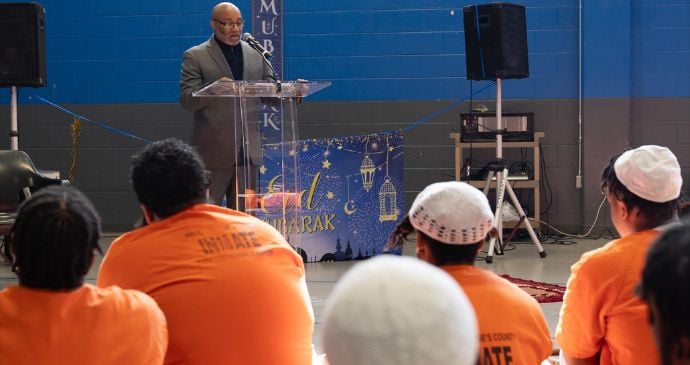
The Maryland office of the Council on American-Islamic Relations (CAIR) today thanked the Prince George’s County Correctional Facility and community partners including the Diyanet Center of America for joining CAIR’s Maryland Muslim Prisoner Project to host a historic Eid luncheon for incarcerated Muslims at the facility last Saturday.
More than a festive meal, the event offered a moment of dignity, recognition, and humanity for individuals who are often overlooked and underserved.
Muslims make up approximately 9 to 18 percent of federal and state prison populations. Many of the Muslim attendees at Saturday’s Eid event were among the tens of thousands of individuals across the United States who embrace Islam annually while serving out their sentence. The faith’s emphasis on discipline, accountability, and personal transformation often draws individuals seeking a path toward purpose, structure, and redemption.
“This Eid luncheon was a powerful reminder that faith continues to liberate even in the most restrictive environments,” said CAIR’s Maryland Advisory Board Member and Maryland Muslim Prison Project Chair Imam Talib Abdus Samad. “It’s a milestone that reflects a unified and committed effort to ensure that incarcerated individuals across Maryland are able to practice their faith with dignity and access to essential religious accommodations. We commend Director Clark, Deputy Brockenbrough and the staff at the Prince George’s County Correctional Facility who helped coordinate this meaningful occasion. Together, we sent a clear message that those who are incarcerated are not forgotten.”
CAIR acknowledges the Diyanet Center of America, Prince George’s County Muslim Council, ICNA Council for Social Justice, HalalCo and many the dedicated volunteers who contributed to this and similar efforts.
CAIR noted that incarcerated Muslims often face challenges in accessing basic religious accommodations, including halal meals and the ability to observe Ramadan and Eid. Saturday’s event reflects what is possible when institutions prioritize respect, inclusion, and religious freedom.
SEE: A Correctional Institution’s Guide to Islamic Religious Practices
“We are grateful to the leadership and staff of the Prince George’s County Correctional Facility for choosing compassion over indifference and respect over neglect,” Abdus Samad added. “This partnership demonstrates that supporting religious freedom is not only a legal obligation, it’s also a meaningful investment in rehabilitation and human dignity.”
CAIR’s Maryland Muslim Prisoner Project remains committed to advocating for the rights of incarcerated Muslims and ensuring that no individual is denied the opportunity to practice their faith.
CAIR’s mission is to protect civil rights, enhance understanding of Islam, promote justice, and empower American Muslims.
La misión de CAIR es proteger las libertades civiles, mejorar la comprensión del Islam, promover la justicia, y empoderar a los musulmanes en los Estados Unidos.
END
CONTACT: CAIR Maryland Director Zainab Chaudry, [email protected], 410-971-6062; CAIR National Communications Director Ibrahim Hooper, 202-744-7726, [email protected]; CAIR National Communications Manager Ismail Allison, 202-770-6280, [email protected]