

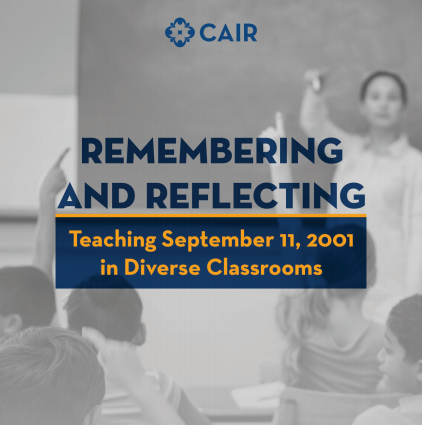
(WASHINGTON, D.C, 8/23/2021) – The Council on American-Islamic Relations (CAIR), the nation’s largest Muslim civil rights and advocacy organization, today released a school resource document with tips and educational resources that teachers can use to teach about the 20th anniversary of the September 11, 2001, attacks.
READ CAIR’S SCHOOL RESOURCE GUIDE
https://www.cair.com/wp-content/uploads/2021/08/SchoolResourcesNew.pdf
“Teaching students about the September 11th attacks and their impact on our nation and the world is critically important,” said CAIR Research and Advocacy Coordinator Huzaifa Shahbaz. “It is just as important to educate students in an accurate way using reliable sources that do not contain anti-Arab or anti-Muslim content.”
Every year, CAIR offices normally receive complaints from students and families about anti-Muslim bullying and Islamophobic rhetoric in classrooms tied to the anniversaries of September 11, 2001. In CAIR surveys, large numbers of Muslim students reported being mocked, verbally harassed, or physically abused because of their faith or ethnicity.
SEE: CAIR-MA Issues First-Ever Report on Muslim Youth Bullying in Massachusetts
CAIR-CA REPORT: 40% of Muslim Students in California Experience Bullying, Discrimination
CAIR designed the school resource document to give teachers additional tools they can use to discuss the 9/11 attacks using vetted and reliable sources.
The resource document includes a list of general lesson plans about 9/11 created by educators, as well as documentaries, news reports and articles that cover both the attacks and their impact on people across America, including American Muslims. The document also includes recommended tips that teachers can use to avoid incidents of bigotry in the classroom during discussion of 9/11.
Examples of tips include:
1. Alert students a few days in advance of the 9/11 lesson plan so that families have time to prepare their children for the discussion.
2. Only use external instructional materials – such as photographs, documentaries, etc. –from vetted, reliable, mainstream sources such a museums and major media outlets.
3. Vet all materials, including internal materials such as textbooks, to ensure that they do not include inaccurate information or inflammatory content.
4. Immediately respond to any incidents of bullying or harassment that occur in the classroom during the lesson plan.
5. Refrain from asking students to engage in educational activities that stimulate the roles of perpetrators, targets, or bystanders.
CAIR National’s 2021 Civil Rights Report, Resilience in the Face of Hate, documented various school-related complaints ranging from bullying, Islamophobic school curriculum, and holiday denials in 2020. Bullying accounted for 44% of all school-related complaints.
SEE: 2021 Civil Rights Report: Resilience in the Face of Hate
https://www.cair.com/wp-content/uploads/2021/04/CAIRReport.pdf
Bias and Bullying in Public Schools: Mitigating the Impact on Muslim and Perceived-as-Muslim Students
http://www.islamophobia.org/images/2019/Bullying/Bias_and_Bullying_White_Paper.pdf
CAIR’s mission is to protect civil rights, enhance understanding of Islam, promote justice, and empower American Muslims.
La misión de CAIR es proteger las libertades civiles, mejorar la comprensión del Islam, promover la justicia, y empoderar a los musulmanes en los Estados Unidos.
Become a Fan of CAIR on Facebook
http://www.facebook.com/CAIRNational
Subscribe to CAIR’s Email List
https://action.cair.com/a/newsletters
Subscribe to CAIR’s Twitter Feed
http://twitter.com/cairnational
Subscribe to CAIR’s YouTube Channel
Follow CAIR on Instagram
https://www.instagram.com/cair_national/
Donate to CAIR
https://action.cair.com/a/donate
Do you like reading CAIR press releases and taking part in our action alerts? You can help contribute to CAIR’s work of defending civil rights and empowering American Muslims across the country by making a one-time contribution or becoming a monthly donor. Supporters like you make CAIR’s advocacy work possible and defeating Islamophobia an achievable goal. Click here to donate to CAIR.
You are receiving this email due to your interest selection from commercial media databases. If you would like join CAIR’s media list, please sign up here: https://action.cair.com/a/newsletters — For more information, email: [email protected], CC [email protected]
END
CONTACT: CAIR National Deputy Director Edward Ahmed Mitchell, 404-285-9530, [email protected]; CAIR Government Affairs Director Robert McCaw, 202-742-6448, [email protected]; CAIR National Communications Director Ibrahim Hooper, 202-744-7726, [email protected]