

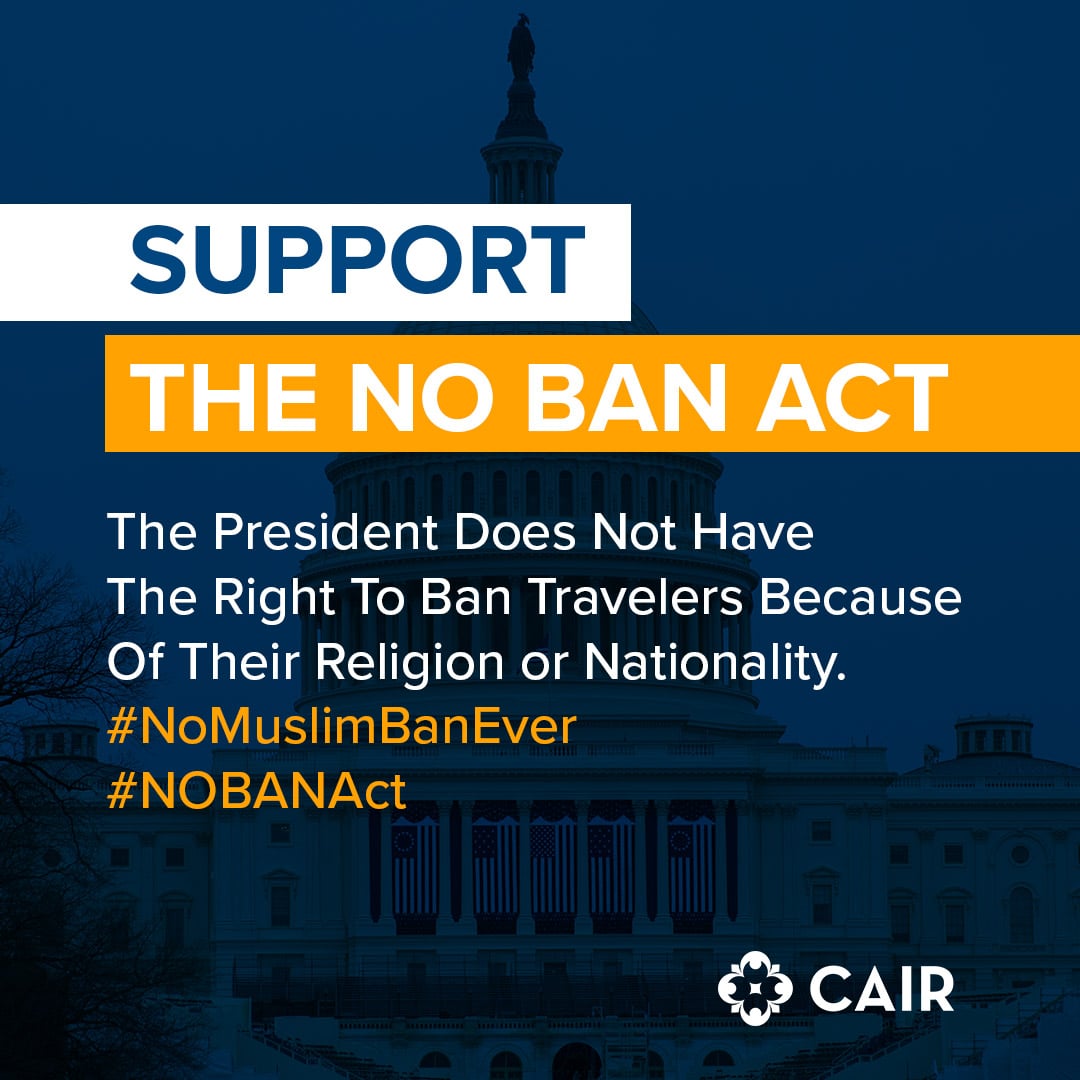
The Council on American-Islamic Relations (CAIR), the nation’s largest Muslim civil rights and advocacy organization, today welcomed the U.S. House and Senate reintroduction of the “National Origin-Based Antidiscrimination for Nonimmigrants Act” also known as the “NO BAN Act” and the “Access to Counsel Act.”
CAIR is urging all Americans who opposed the Trump administration’s discriminatory Muslim and African travel bans and harassment of travelers at the U.S. border based on their race, color, religion, or nationality to urge their members of Congress to co-sponsor and support these acts today.
CLICK HERE: URGE CONGRESS TO SUPPORT THE NO BAN ACT & ACCESS TO COUNSEL ACT
SEE: Sens. Coons, Padilla introduce two bills to prevent future Muslim bans (senate.gov)
Championed by Representative Judy Chu (D-CA) and Senator Chris Coons (D-DE), the act is a preventative response to former President Donald Trump’s proclamations banning travel or immigration by nationals of several, mostly Muslim, countries. Trump had said the bans were necessary for security and counterterrorism. In April 2021, CAIR applauded the House’s passage of the NO BAN Act.
The Access to Counsel Act, championed by Senator Padilla (D-CA) and Representative Pramila Jayapal (D-WA), guarantees that U.S. citizens, green card holders, and valid visa holders can consult with an attorney, family member, or other interested party if detained by Customs and Border Protection (CBP) at airports or other ports of entry.
About the NO BAN ACT
- Under the bill, admission to the U.S. could be blocked or otherwise restricted only when “specific and credible facts” support a determination by DHS that entry would undermine U.S. security or public safety, human rights, democratic processes, or international stability.
- Before a restriction could take effect, the State and Homeland Security departments would have to provide evidence for the determination to Congress. They also would have to provide a briefing and report within 48 hours of issuing restrictions, or else they would automatically end. An unclassified version of the report would have to be published in the Federal Register.
- An additional report would have to be provided to Congress every 30 days while the restrictions are in effect, or they would automatically terminate, and a final report would be due 30 days after the restrictions are lifted. The reports would have to be publicly available online.
- Executive actions to limit entry would have to specify a duration and use the least restrictive means to address the concern. Waivers would be available, specifically for family-based and humanitarian concerns.
- The measure would allow private suits, including class actions, by anyone present in the U.S. who is harmed by a violation of the limits imposed by the bill.
- The bill would also transfer to DHS the Justice Department’s existing authority to block entry by noncitizens traveling on a commercial airline that hasn’t complied with rules related to detecting fraudulent documents.
About the Access to Counsel Act
- Requires the Department of Homeland Security to ensure that people with valid travel documents who present themselves at the border, airports, or other points of interaction can communicate with counsel and other interested parties if they are subjected to prolonged inspection by CBP.
- Allows counsel or a covered interested party the ability to advocate on behalf of the individual by providing information or documentation in support of the individual.
- Invalidates any effort by CBP to persuade someone to relinquish their legal status (by executing an I-407 or Record of Abandonment of Lawful Permanent Resident Status) if that person has been denied access to counsel.
The NO BAN Act and Access to Counsel Act are two of the twenty-five measures supported in CAIR’s report “CAIR Congressional Legislative Priorities in the 118th Congress.”
END
CONTACT: CAIR National Deputy Director Edward Ahmed Mitchell, 404-285-9530, [email protected]; CAIR Government Affairs Director Robert McCaw, 202-742-6448, [email protected]; CAIR National Communications Director Ibrahim Hooper, 202-744-7726, [email protected] CAIR National Communications Manager Ismail Allison, 202-770-6280, [email protected]