

(WASHINGTON, DC, 7/1/2021) – The Council on American-Islamic Relations (CAIR), the nation’s largest Muslim civil rights and advocacy organization, today welcomed the U.S. Supreme Court’s decision in Americans for Prosperity v. Bonta affirming the right of nonprofit and civil rights organizations to maintain the confidentiality of their members and donors.
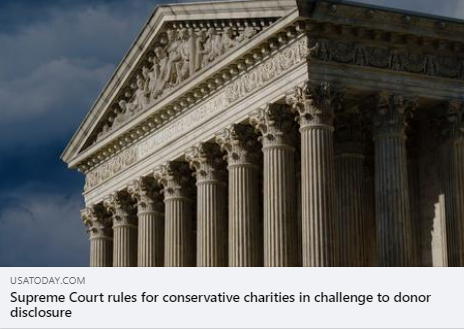
SEE: Supreme Court rules for conservative charities in challenge to donor disclosure
The Court affirmed that California’s requirement that charitable organizations provide the state government with tax information that unnecessarily discloses detailed donor data violates the First Amendment.
As the Court explained, the chilling effect on the First Amendment’s guaranteed right to association based on the potential that information would leak to the public was profound. “When it comes to the freedom of association, the protections of the First Amendment are triggered not only by actual restrictions on an individual’s ability to join with others to further shared goals. The risk of a chilling effect on association is enough.”
Earlier this year, CAIR filed an amicus brief in this case that explained how governments improperly use bulk collection of data to target disfavored minorities. As its amicus brief described, “[t]he federal terrorist watchlist system rests on a foundation of bulk collection and analysis of American Muslims’ associations.”
SEE: CAIR Files SCOTUS Amicus Brief Challenging Federal Government’s Collection of Donor Information
Read CAIR’s Amicus Brief
https://www.cair.com/wp-content/uploads/2021/02/AFPAmicus.pdf
CAIR’s brief was noted by Chief Justice Roberts in the Supreme Court’s majority opinion. Specifically mentioning CAIR’s brief, among others, the Supreme Court recognized CAIR’s concerns. “The deterrent effect feared by these organizations is real and pervasive, even if their concerns are not shared by every single charity operating or raising funds in California.”
Read the Decision:
https://www.supremecourt.gov/opinions/20pdf/19-251_p86b.pdf
CAIR’s Civil Rights Director, Lena Masri lauded the Court’s decision: “Our ability to protect members and donors from reprisal is what allows us to fight for our rights as a community. This decision protects not only CAIR, but also the American Muslim and civil rights communities.”
“As the majority recognized, governments used association data to target civil rights organizations,” said CAIR Trial Attorney Justin Sadowsky. “The Supreme Court reaffirmed Civil Rights Era decisions holding that collection of such information unconstitutional because it could be used for targeting as just as important today as it was then. The First Amendment’s protection of the freedom of association continues to remain valid today, particularly in the digital age.”
Earlier today, CAIR said a decision by the U.S. Supreme Court to uphold two Arizona election laws that make it harder for voters to cast their ballots was a “blow to democracy,” but that voters will be even more motivated to cast their ballots.
BREAKING: CAIR Says SCOTUS Decision Upholding Arizona Voting Restrictions Will Ultimately Motivate Targeted Voters
CAIR’s mission is to protect civil rights, enhance understanding of Islam, promote justice, and empower American Muslims.
La misión de CAIR es proteger las libertades civiles, mejorar la comprensión del Islam, promover la justicia, y empoderar a los musulmanes en los Estados Unidos.
Become a Fan of CAIR on Facebook
http://www.facebook.com/CAIRNational
Subscribe to CAIR’s Email List
https://action.cair.com/a/newsletters
Subscribe to CAIR’s Twitter Feed
http://twitter.com/cairnational
Subscribe to CAIR’s YouTube Channel
Follow CAIR on Instagram
https://www.instagram.com/cair_national/
Donate to CAIR
https://action.cair.com/a/donate
Do you like reading CAIR press releases and taking part in our action alerts? You can help contribute to CAIR’s work of defending civil rights and empowering American Muslims across the country by making a one-time contribution or becoming a monthly donor. Supporters like you make CAIR’s advocacy work possible and defeating Islamophobia an achievable goal. Click here to donate to CAIR.
To opt-out of future mailings, email: info@cair.com, CC ihooper@cair.com
END
CONTACT: CAIR National Litigation Director Lena Masri, 248-390-9784, lmasri@cair.com; CAIR Senior Litigation Attorney Gadeir Abbas, 720-251-0425, gabbas@cair.com; CAIR Trial Attorney Justin Sadowsky, 646-785-9154, jsadowsky@cair.com; CAIR National Communications Director Ibrahim Hooper, 202-744-7726, ihooper@cair.com